4 Laws of football
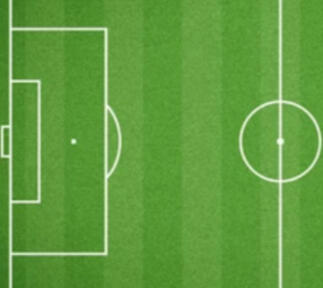
Law 1 : The field
Surface:
The field can be made of natural grass or artificial turf, or a combination of the two. The surface must be green.Shape:
The field must be rectangular.Dimensions:
The touchline must be longer than the goal line.The regulation dimensions are:
Touchline:
Minimum 90 meters (100 yards), maximum 120 meters (130 yards)Goal line:
Minimum 45 meters (50 yards), maximum 90 meters (100 yards)Markings:
The field must be marked with continuous, non-dangerous lines.Goal areas:
Two lines are drawn at right angles to the goal line, 6 yards from the inside of each goalpost to define the goal area.Penalty areas:
Two lines are drawn at right angles to the goal line, 18 yards from the inside of each goalpost to define the penalty area.Corner areas:
A quarter circle with a radius of 1 yard is drawn from each corner flag post to define the corner area.Center point:
A marked center point is located at the midpoint of the halfway line. A lined center circle with a radius of 10 yards surrounds the center point.

Law 2 : The ball
Requirements :
The ball must be spherical, made of suitable material, and have a circumference of 68–70 cm (27–28 in). It must also weigh 410–450 g (14–16 oz) at the start of the match and have a pressure of 0.6–1.1 atmosphere (600–1,100 g/cm2) at sea level.Replacement :
If the ball becomes defective, play stops and restarts with a dropped ball. If the ball becomes defective during a penalty kick, the penalty kick is retaken. The ball can't be changed during the match without the referee's permission.Additional balls :
Additional balls that meet the requirements of Law 2 can be placed around the field of play. The referee controls their use.
Law 3 : The players
Number of players :
Each team has a maximum of 11 players, including one goalkeeper. A match can't start or continue if a team has fewer than seven players.Substitutions :
The maximum number of substitutes allowed is three, but there is no limit to the number of substitutions that can be made during a game. Substitutions can only be made when the ball is in or out of play, and the player entering the field must wait until the player leaving has completely crossed the boundary line.Multiple substitutions :
If both teams make a substitution at the same time, it counts as one substitution for each team. Multiple substitutions made by a team during a stoppage in play count as one substitution.Competition rules :
Competition rules specify the number of substitutes that can be named, which can range from three to 15. They may also specify whether an extra substitute can be used if the match goes into extra time.


Law 4 : Players Equipment
Safety :
Players cannot wear or use anything that is dangerous, such as jewelry, tape-covered jewelry, or undergarments with slogans or advertising.Equipment :
Players must wear a shirt, shorts, socks, shoes, and proper shin protection. Goalkeepers can wear tracksuit bottoms.
Inspections
Players and substitutes must be inspected before the start of the match and before entering the field of play.Lost equipment :
If a player accidentally loses their footwear or shinguard, they must replace it as soon as possible. If they play the ball or score a goal before replacing it, the goal is awarded.Armbands :
The team captain must wear an armband that is authorized by the competition organizer. The armband can be single-colored, or it can have the word "captain" or the letter "C" on it.
" If you know the rulers', you can do anything you want"
- Anonymous
Thanks to : Google, Gemini Ai, Carrd
Source written by : Jihaan Mehul Patel
Student of grade 7 Fountainhead school, surat
Published by : Carrd
Published on : 14 / dec / 2024